Songkick
Web Redesign
Impact
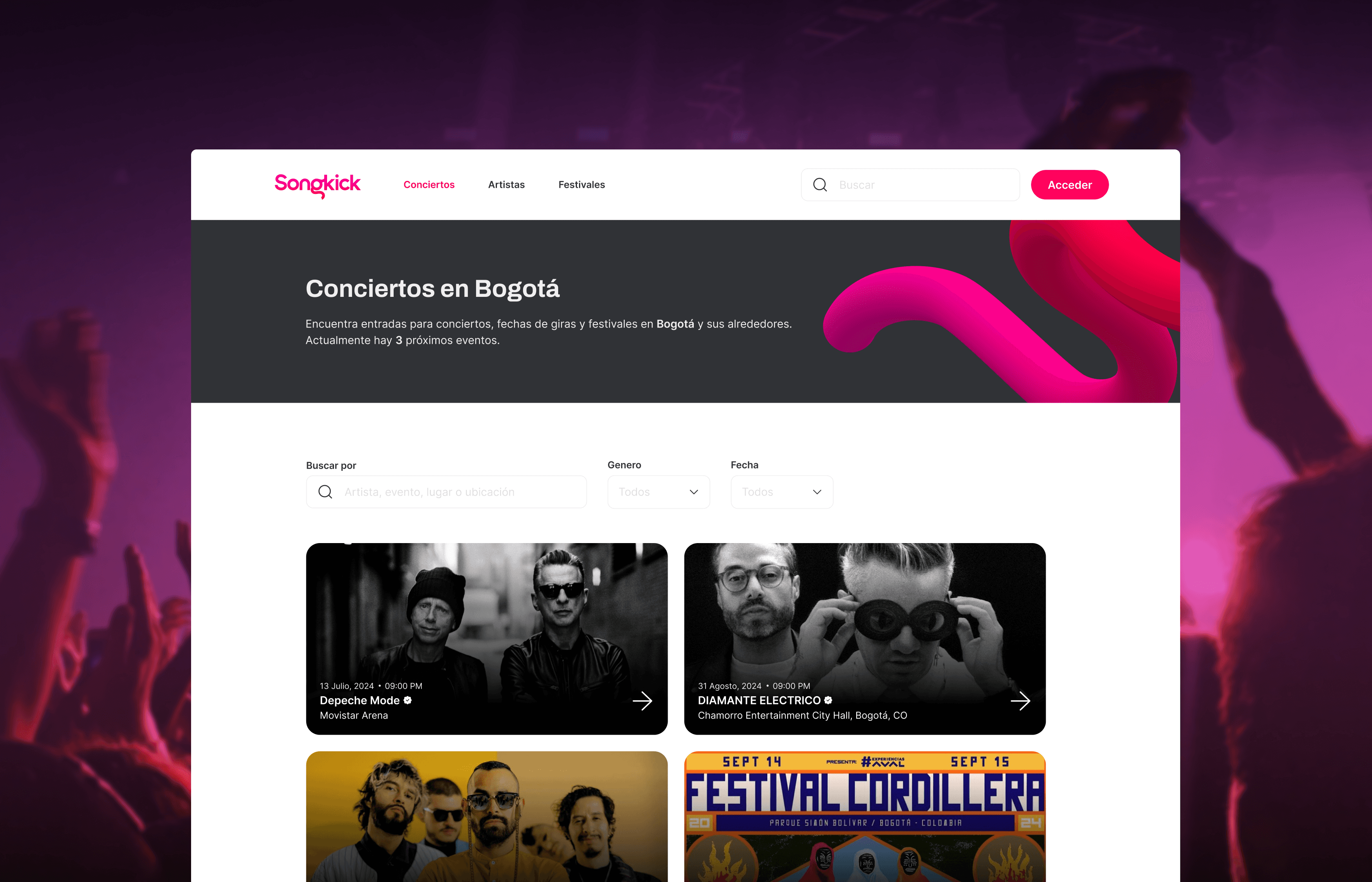
- Redesigned the complete experience of a platform used by more than 15 million music fans worldwide, with over 6 million concerts and festivals listed.
- 4 out of 5 users in usability testing successfully completed the task of searching for concerts, validating that the structural and orientation improvements worked.
[ Project image ]
Context
- Songkick is a digital platform that lets people discover nearby concerts and music events, follow artists, and receive personalized concert alerts.
- Developed as an individual case study during an Advanced UX/UI Design bootcamp.
- Market references: Eventbrite and Last.fm.
[ Project image ]
Challenge
- New users landed on an empty homepage, with no clear guidance on how to get started.
- Visual inconsistencies created confusion and a sense of illegitimacy.
- Hard to distinguish between original artist events and tribute shows.
- No accessible way to report suspicious ticket sale links — only a long form buried in the site.
- No budget for formal user research.
[ Project image ]
My role
- Led the entire project solo, from research through final UI.
- Methods applied: competitive benchmarking, user surveys (10 respondents), Lean UX Canvas, user archetypes, 5 Elements of UX framework, UX writing with a voice matrix, design system, motion design, remote usability test with 5 users (Think Aloud method).
- Tools: Figma (flows, wireframes, interactive prototype), Zoom (remote testing).
[ Project image ]
Solution
- Strategy: Hypotheses from surveys and competitive analysis; user archetypes (registered user, guest user, notification seeker, someone needing guidance).
- Scope: Features and content defined to solve each identified problem.
- Structure: User flows and system responses designed for two main user profiles.
- Skeleton: UX writing with a voice matrix (clarity, conversational tone, honesty) and design principles (human, experiential, effortless).
- Surface: Complete design system — Archivo and Inter typography, color palette, components, iconography, cards — plus motion design with animations defined in Figma.
- Added an accessible mechanism for reporting fake ticket links, solving one of the platform's critical trust issues.
[ Project image ]
Results
- Usability test with 5 users (ages 17–32), remote sessions via Zoom using Think Aloud method.
- 4 out of 5 users successfully completed the task of searching for concerts.
- Users easily found how to report a fake link — validating the solution to one of the platform's critical trust problems.
- Friction points identified for future iterations: confusion around the "+1" in the filter dropdown, and navigation issues when viewing concert details.
- Project concluded at the findings and recommendations stage; a second iteration of the prototype was not implemented.